
- There are several kinds of yew including the English or European yew (Taxus baccata), Pacific yew (Taxus brevifolia) and Japanese yew (Taxus cuspidata). All species are considered poisonous; however, there is some debate about the medicinal value of the fruits (arils). The name 'taxus' may be related to the Greek 'toxon' (bow) and 'toxicon' (the poison with which the arrowheads were dressed).
- Traditionally, the fruit of yew has been used as an antitussive (preventing or relieving cough), menstrual stimulant, abortifacient (induces abortion), diuretic and laxative. It is reported that the Native Americans used yew extracts to treat rheumatism, fever, and arthritis.
- Paclitaxel (Taxol®) was isolated from the bark of the Pacific yew tree (Taxus brevifolia) as early as 1971 and is now approved by the U.S. Food and Drug Administration (FDA). Since 1971, Taxol® has been used as an antitumor drug in clinical trials run by the U.S. National Cancer Institute and has been hailed as one of the most significant advances in cancer chemotherapy in recent history. Since 1990, clinical trials using Taxol® have succeeded in treating advanced ovarian and breast cancers.
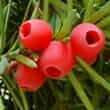
Ingredients
Yew (Taxus baccata, Taxus brevifolia, Taxus cuspidata, Taxus canadensis)
Explore the available health information, treatment context, and integrative evidence for Yew (Taxus baccata, Taxus brevifolia, Taxus cuspidata, Taxus canadensis).
Evidence Ledger
Grades describe the evidence for Yew (Taxus baccata, Taxus brevifolia, Taxus cuspidata, Taxus canadensis) relative to each listed condition or goal.
Background
References
- Anderson BD, Shepherd JG, Manoguerra AS. Yew toxicity less than ipecac. J.Toxicol.Clin.Toxicol. 1998;36(7):749-750.
View Abstract - Burris HA, III Fields S, Peacock N. Docetaxel (Taxotere) in combination: a step forward. Semin.Oncol. 1995;22(6 Suppl 13):35-40.
View Abstract - Kobayashi J, Hosoyama H, Wang XX, et al. Modulation of multidrug resistance by taxuspine C and other taxoids from Japanese yew. Bioorg.Med.Chem.Lett. 6-16-1998;8(12):1555-1558.
View Abstract - Krenzelok EP, Jacobsen TD, Aronis J. Is the yew really poisonous to you? J.Toxicol.Clin.Toxicol. 1998;36(3):219-223.
View Abstract - Lavelle F, Gueritte-Voegelein F, Guenard D. [Taxotere: from yew's needles to clinical practice]. Bull.Cancer 1993;80(4):326-338.
View Abstract - Maguchi S, Fukuda S. Taxus cuspidata (Japanese yew) pollen nasal allergy. Auris Nasus Larynx 2001;28 Suppl:S43-S47.
View Abstract - Musshoff F, Jacob B, Fowinkel C, Daldrup T. Suicidal yew leave ingestion--phloroglucindimethylether (3,5-dimethoxyphenol) as a marker for poisoning from Taxus baccata. Int.J.Legal Med. 1993;106(1):45-50.
View Abstract - Stebbing J, Simmons HL, Hepple J. Deliberate self-harm using yew leaves (Taxus baccata). Br.J.Clin.Pract. 1995;49(2):101.
View Abstract - Stierle A, Strobel G, Stierle D. Taxol and taxane production by Taxomyces andreanae, an endophytic fungus of Pacific yew. Science 4-9-1993;260(5105):214-216.
View Abstract - Valero V. Primary chemotherapy with docetaxel for the management of breast cancer. Oncology (Williston.Park) 2002;16(6 Suppl 6):35-43.
View Abstract - von der Werth J, Murphy JJ. Cardiovascular toxicity associated with yew leaf ingestion. Br.Heart J. 1994;72(1):92-93.
View Abstract - Wasielewski S. [Taxol--cytostatic drug from the yew tree]. Med.Monatsschr.Pharm. 1993;16(2):36-37.
View Abstract - Wehner F, Gawatz O. [Suicidal yew poisoning--from Caesar to today--or suicide instructions on the internet]. Arch.Kriminol. 2003;211(1-2):19-26.
View Abstract - Willaert W, Claessens P, Vankelecom B, Vanderheyden M. Intoxication with taxus baccata: cardiac arrhythmias following yew leaves ingestion. Pacing Clin.Electrophysiol. 2002;25(4 Pt 1):511-512.
View Abstract - Wilson CR, Sauer J, Hooser SB. Taxines: a review of the mechanism and toxicity of yew (Taxus spp.) alkaloids. Toxicon 2001;39(2-3):175-185.
View Abstract