
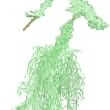
- Usnea species are classified as fruticose lichens, which are a symbiosis of fungus and algae. Usnea grows on the bark and wood of coniferous (e.g., spruces, firs, and pines) and deciduous hardwood (e.g., oak, hickory, walnut, apple, and other fruit trees) host trees throughout the northern hemisphere in Asia, Europe, and North America.
- Usnea has been used as a therapeutic agent in traditional Chinese medicine (TCM) for thousands of years. Usnea longissima is traditionally taken by mouth for lung and upper respiratory infections, and applied on the skin to treat surface infections or external ulcers. It is still used today in TCM in liquid extract and tincture form to treat tuberculosis lymphadenitis.
- Usnic acid is a secondary metabolite uniquely found in all lichens. Usnea or usnic acid has been used as a human papillomavirus (HPV) treatment and as an oral hygiene agent, with limited effectiveness.
- Usnic acid is also found in various oral (by mouth) dietary supplements, including Lipokinetix®, marketed as a weight loss agent. However, Lipokinetix® may not be safe and may cause liver damage. Lipokinetix®, now withdrawn from the market, contained phenylpropanolamine (PPA), caffeine, yohimbine hydrochloride, diiodothyronine and usnic acid.
Ingredients
Usnea
Explore the available health information, treatment context, and integrative evidence for Usnea.
Evidence Ledger
Grades describe the evidence for Usnea relative to each listed condition or goal.
Background
References
- Aalto-Korte K, Lauerma A, Alanko K. Occupational allergic contact dermatitis from lichens in present-day Finland. Contact Dermatitis 2005;52(1):36-38.
View Abstract - Arneborn P, Jansson A, Bottiger Y. [Acute hepatitis in a woman after intake of slimming pills bought via Internet]. Lakartidningen 7-11-2005;102(28-29):2071-2072.
View Abstract - Behera BC, Verma N, Sonone A, et al. Antioxidant and antibacterial activities of lichen Usnea ghattensis in vitro. Biotechnol Lett 2005;27(14):991-995.
View Abstract - Behera BC, Verma N, Sonone A, et al. Evaluation of antioxidant potential of the cultured mycobiont of a lichen Usnea ghattensis. Phytother.Res 2005;19(1):58-64.
View Abstract - Choudhary MI, Azizuddin Jalil S, Atta ur Rahman. Bioactive phenolic compounds from a medicinal lichen, Usnea longissima. Phytochemistry 2005;66(19):2346-2350.
View Abstract - De Carvalho EA, Andrade PP, Silva NH, et al. Effect of usnic acid from the lichen Cladonia substellata on Trypanosoma cruzi in vitro: an ultrastructural study. Micron. 2005;36(2):155-161.
View Abstract - Halici M, Odabasoglu F, Suleyman H, et al. Effects of water extract of Usnea longissima on antioxidant enzyme activity and mucosal damage caused by indomethacin in rats. Phytomedicine 2005;12(9):656-662.
View Abstract - Hsu LM, Huang YS, Chang FY, et al. 'Fat burner' herb, usnic Acid, induced acute hepatitis in a family. J Gastroenterol.Hepatol. 2005;20(7):1138-1139.
View Abstract - Kathirgamanathar S, Williams DE, Andersen RJ, et al. Beta-orcinol depsidones from the lichen Usnea sp. from Sri Lanka. Nat Prod Res 2005;19(7):695-701.
View Abstract - Lee KA, Kim MS. Antiplatelet and antithrombotic activities of methanol extract of Usnea longissima. Phytother Res 2005;19(12):1061-1064.
View Abstract - Mayer M, O'Neill MA, Murray KE, et al. Usnic acid: a non-genotoxic compound with anti-cancer properties. Anticancer Drugs 2005;16(8):805-809.
View Abstract - Odabasoglu F, Cakir A, Suleyman H, et al. Gastroprotective and antioxidant effects of usnic acid on indomethacin-induced gastric ulcer in rats. J Ethnopharmacol 1-3-2006;103(1):59-65.
View Abstract - Saenz MT, Garcia MD, Rowe JG. Antimicrobial activity and phytochemical studies of some lichens from south of Spain. Fitoterapia 2006;77(3):156-159.
View Abstract - Sanchez W, Maple JT, Burgart LJ, et al. Severe hepatotoxicity associated with use of a dietary supplement containing usnic acid. Mayo Clin Proc 2006;81(4):541-544.
View Abstract - Wang XP, Liu HJ, Zhen L, et al. [Plasmid elimination effect of usnic acid on antibiotic-resistant Staphylococcus aureus]. Zhong.Yao Cai. 2006;29(1):36-39.
View Abstract