
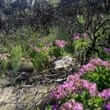
- Pelargonium sidoides, also known as umckaloabo, is a member of the Geranium family and is native to South Africa. The name umckaloabo is derived from two independent Zulu words: "umkhuhlane," meaning fever and cough related diseases, and "uhlabo," meaning chest pain.
- For centuries the roots of Pelargonium sidoides DC have been used in traditional South African medicine for the treatment of respiratory diseases, diarrhea, dysmenorrhea (painful menstruation), and liver disorders. Extracts of the root have been available in German pharmacies since 1983 without prescription and have been widely used to treat infections of the sinus, throat, and respiratory tract. In modern times, an aqueous formulation of the roots of Pelargonium sidoides called EPs 7630 has been studied in humans as a potential treatment for bronchitis (acute), acute pharyngitis (acute non-group A beta-hemolytic streptococcus tonsillopharyngitis), and the common cold.
Ingredients
Umckaloabo (Pelargonium sidoides)
Explore the available health information, treatment context, and integrative evidence for Umckaloabo (Pelargonium sidoides).
Evidence Ledger
Grades describe the evidence for Umckaloabo (Pelargonium sidoides) relative to each listed condition or goal.
Background
References
- Bereznoy, VV, Riley, DS, Wassmer, G, et al. Efficacy of extract of Pelargonium sidoides in children with acute non-group A beta-hemolytic streptococcus tonsillopharyngitis: a randomized, double-blind, placebo-controlled trial. Altern Ther Health Med 2003;9(5):68-79.
View Abstract - Chuchalin, AG, Berman, B, and Lehmacher, W. Treatment of acute bronchitis in adults with a pelargonium sidoides preparation (EPs 7630): a randomized, double-blind, placebo-controlled trial. Explore (NY) 2005;1(6):437-445.
View Abstract - de Boer, HJ, Hagemann, U, Bate, J, et al. Allergic reactions to medicines derived from Pelargonium species. Drug Saf 2007;30(8):677-680.
View Abstract - Lizogub, VG, Riley, DS, and Heger, M. Efficacy of a pelargonium sidoides preparation in patients with the common cold: a randomized, double blind, placebo-controlled clinical trial. Explore (NY) 2007;3(6):573-584.
View Abstract - Matthys, H and Heger, M. Treatment of acute bronchitis with a liquid herbal drug preparation from Pelargonium sidoides (EPs 7630): a randomised, double-blind, placebo-controlled, multicentre study. Curr Med Res Opin 2007;23(2):323-331.
View Abstract - Matthys, H, Eisebitt, R, Seith, B, et al. Efficacy and safety of an extract of Pelargonium sidoides (EPs 7630) in adults with acute bronchitis. A randomised, double-blind, placebo-controlled trial. Phytomedicine 2003;10 Suppl 4:7-17.
View Abstract - Schulz, V. Liquid herbal drug preparation from the root of Pelargonium sidoides is effective against acute bronchitis: results of a double-blind study with 124 patients. Phytomedicine 2007;14 Suppl 6:74-75.
View Abstract