
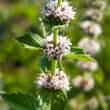
- Spearmint (Mentha viridis or Mentha spicata) is a species of mint plant native to Europe and Asia that grows well in nearly all temperate climates. The name is derived from the plant's spear-like pointed leaf tips. It is an invasive species in the Great Lakes region of the United States.
- Spearmint is grown for its aromatic and carminative essential oil, called oil of spearmint. Spearmint leaves can be used whole; chopped; dried; dried and ground; frozen; or preserved in salt, sugar, sugar syrup, alcohol, or oil.
- Spearmint is an ingredient in several alcoholic drinks, such as the mojito and mint julep. Sweet tea, iced and flavored with spearmint, is a summer tradition in the southern United States. It is used as a flavoring for toothpaste and confectionery, and it is sometimes added to shampoos and soaps. The cultivar Mentha spicata 'Nana', the Nana mint of Morocco, possesses a clear and pungent, but mild, aroma and is an essential ingredient of Touareg tea.
- Spearmint-based sprays have been used to control pests, such as weevils, mites, greenhouse whiteflies, sciarid flies, roundworms, and nematodes.
- In folk medicine, spearmint has been used for gastrointestinal distress, respiratory problems, stomachache, dandruff, bad breath, and chronic bronchitis. It has also been used as a sedative, abortifacient, and menstruation stimulant (emmenagogue).
- Some human research suggests that drinking spearmint tea may help reduce excessive hair growth (called hirsutism) in women with polycystic ovarian syndrome (PCOS). Early evidence suggests that an herbal combination product containing spearmint may help treat irritable bowel syndrome. It is unclear if chewing spearmint-flavored gum improves memory; evidence is mixed.
- At this time, high-quality human trials do not support the use of spearmint for any indication. Better-designed clinical trials are needed before conclusions can be made regarding taking this agent for any condition.
- Spearmint, spearmint extract, and spearmint oil are listed on the FDA Generally Recognized as Safe (GRAS) list.
- Caution is warranted, as spearmint has been found to dose-dependently cause liver and kidney damage. Allergic reactions to spearmint and spearmint oil have been reported.
- Although it is commonly recommended that patients with gastrointestinal reflux disease avoid spearmint and peppermint, research in healthy individuals suggests that spearmint may not affect esophageal sphincter function and acid reflux.
Ingredients
Spearmint (Mentha spicata, Mentha viridis)
Explore the available health information, treatment context, and integrative evidence for Spearmint (Mentha spicata, Mentha viridis).
Evidence Ledger
Grades describe the evidence for Spearmint (Mentha spicata, Mentha viridis) relative to each listed condition or goal.
Background
References
- Akdogan, M, Tamer, MN, Cure, E, et al. Effect of spearmint (Mentha spicata Labiatae) teas on androgen levels in women with hirsutism. Phytother.Res 2007;21(5):444-447.
View Abstract - Baker, JR, Bezance, JB, Zellaby, E, et al. Chewing gum can produce context-dependent effects upon memory. Appetite 2004;43(2):207-210.
View Abstract - Bonamonte, D, Mundo, L, Daddabbo, M, et al. Allergic contact dermatitis from Mentha spicata (spearmint). Contact Dermatitis 2001;45(5):298.
View Abstract - Bulat, R, Fachnie, E, Chauhan, U, et al. Lack of effect of spearmint on lower oesophageal sphincter function and acid reflux in healthy volunteers. Aliment.Pharmacol Ther. 1999;13(6):805-812.
View Abstract - Clayton, R and Orton, D. Contact allergy to spearmint oil in a patient with oral lichen planus. Contact Dermatitis 2004;51(5-6):314-315.
View Abstract - Grant, P. Spearmint herbal tea has significant anti-androgen effects in polycystic ovarian syndrome. a randomized controlled trial. Phytother Res 7-7-2009.
View Abstract - Johnson, AJ and Miles, C. Chewing gum and context-dependent memory: the independent roles of chewing gum and mint flavour. Br J Psychol 2008;99(Pt 2):293-306.
View Abstract - Johnson, AJ and Miles, C. Evidence against memorial facilitation and context-dependent memory effects through the chewing of gum. Appetite 2007;48(3):394-396.
View Abstract - Larsen, W, Nakayama, H, Fischer, T, et al. Fragrance contact dermatitis: a worldwide multicenter investigation (Part II). Contact Dermatitis 2001;44(6):344-346.
View Abstract - Miles, C and Johnson, AJ. Chewing gum and context-dependent memory effects: a re-examination. Appetite 2007;48(2):154-158.
View Abstract - Ormerod, AD and Main, RA. Sensitisation to "sensitive teeth" toothpaste. Contact Dermatitis 1985;13(3):192-193.
View Abstract - Poon, TS and Freeman, S. Cheilitis caused by contact allergy to anethole in spearmint flavoured toothpaste. Australas J Dermatol 2006;47(4):300-301.
View Abstract - Tomson, N, Murdoch, S, and Finch, TM. The dangers of making mint sauce. Contact Dermatitis 2004;51(2):92-93.
View Abstract - Torney, LK, Johnson, AJ, and Miles, C. Chewing gum and impasse-induced self-reported stress. Appetite 2009;53(3):414-417.
View Abstract - Tucha, O, Mecklinger, L, Maier, K, et al. Chewing gum differentially affects aspects of attention in healthy subjects. Appetite 2004;42(3):327-329.
View Abstract