
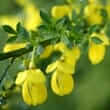
- Scotch broom (Cytisus scoparius), also referred to as broom, is a perennial woody plant native to Europe. The species was introduced as a garden ornamental to North America and now is common across western Canada and California. Scotch broom plants grow up to 10 feet tall with sharply angled branches off the main stem, trifoliate leaves, and bright yellow small flowers. Scotch broom spreads quickly and aggressively at the expense of other plants and trees and is often considered a pest.
- Both the flower and herb of scotch broom have been used medicinally. There is very little available scientific evidence about the efficacy or safety of this plant, and most conclusions come from knowledge of its constituents or from traditional use. There is particular concern about the potential toxicity of scotch broom due to the presence of small amounts of the toxic alkaloids sparteine and isosparteine, which are found in both the flowers and herb (above-ground parts). Sparteine has known effects on the electrical conductivity of heart muscle and can potentially cause dangerous heart rhythms or interact with cardiac drugs. Sparteine is also known to cause uterine contractions and should be avoided during pregnancy. Life-threatening adverse effects have been associated with sparteine and therefore scotch broom should be used only under strict medical supervision.
Ingredients
Scotch broom (Cytisus scoparius Linn.) herb and flower, sparteine
Explore the available health information, treatment context, and integrative evidence for Scotch broom (Cytisus scoparius Linn.) herb and flower, sparteine.
Evidence Ledger
Grades describe the evidence for Scotch broom (Cytisus scoparius Linn.) herb and flower, sparteine relative to each listed condition or goal.
Background
References
- Dipont M. [Effects of sparteine on uterus contractility during labor]. Ginekol Pol 1971;42(5):657-663.
View Abstract - Eichelbaum M, Spannbrucker N, Dengler HJ. Influence of the defective metabolism of sparteine on its pharmacokinetics. Eur J Clin Pharmacol 1979;16(3):189-194.
View Abstract - Gram LF, Debruyne D, Caillard V, et al. Substantial rise in sparteine metabolic ratio during haloperidol treatment. Br J Clin Pharmacol 1989;27(2):272-275.
View Abstract - Jusiak L, Soczewinski E, Waksmundzki A. Analysis of alkaloid extract of broom (Cystisus scoparius) by chromatography on wet buffered paper and countercurrent distribution. Acta Pol Pharm 1967;24(6):619-624.
- Kolodziejski J, Gill S, Lucziewicz I. [Localization of sparteine in Cytisus scoparius link. (Sarothamnus scoparius L. Wimm.) during the vegetation stage.]. Acta Pol Pharm 1964;21:501-508.
View Abstract - Lacinova L. [Sparteine and tedisamil inhibit chloride channels in pulmonary epithelial cells isolated from patients with cystic fibrosis]. Bratisl Lek Listy 1992;93(8):411-414.
View Abstract - Magnin P, Charrier J, Chapuis Y. [Importance of sparteine in directed labor]. Presse Med 1968;76(18):859-860.
View Abstract - Mangin P, Kintz P, Tracqui A, et al. A fatal ingestion of sparteine and meprobamate: medicolegal and toxicological data. Acta Med Leg Soc (Liege) 1989;39(1):385-388.
View Abstract - Mendel EB. Oxytocin and sparteine in the conduct of the third and fourth stages of labor. South Med J 1970;63(2):193.
View Abstract - Mendel EB, Buring DM. Use of oxytocin and sparteine in postpartum hemorrhage caused by uterine atony. Tex Med 1972;68(4):101-103.
View Abstract - Raschack M. [Actions of sparteine and sparteine derivatives on the heart and circulation]. Arzneimittelforschung 1974;24(5):753-759.
View Abstract - Schellens JH, Soons PA, van der Wart JH, et al. Lack of pharmacokinetic interaction between nifedipine, sparteine and phenytoin in man. Br J Clin Pharmacol 1991;31(2):175-178.
View Abstract - Thies PW. [Spartium and sparteine. Its antiarrhythmia action]. Pharm Unserer Zeit 1986;15(6):172-176.
View Abstract - Veningerova M, Prachar V, Lukacsova M, et al. Rapid determination of sparteine and its metabolites in urine. J Chromatogr 1993;622(2):274-277.
View Abstract