
- Savory is an aromatic plant used in cooking to enhance flavor. Summer savory (Satureja hortensis) and winter savory (Satureja montana) are the two types most commonly used. A commonly studied constituent is carvacrol.
- Savory is native to the Mediterranean region but has been used across Europe, North America, and South America as a seasoning for meats and salads.
- In traditional medicine, savory is used to treat diarrhea, nausea, cramps, muscle pain, indigestion, and infectious diseases. Limited evidence suggests that savory may help lower cholesterol in diabetics.
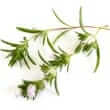
Ingredients
Savory (Satureja spp., Satureja hortensis, Satureja montana)
Explore the available health information, treatment context, and integrative evidence for Savory (Satureja spp., Satureja hortensis, Satureja montana).
Evidence Ledger
Grades describe the evidence for Savory (Satureja spp., Satureja hortensis, Satureja montana) relative to each listed condition or goal.
Background
References
- Baser KH. Biological and pharmacological activities of carvacrol and carvacrol bearing essential oils. Curr Pharm Des 2008;14(29):3106-19.
View Abstract - Carramiñana JJ, Rota C, Burillo J, et al. Antibacterial efficiency of Spanish Satureja montana essential oil against Listeria monocytogenes among natural flora in minced pork. J Food Prot 2008;71(3):502-8.
View Abstract - Cetojevic-Simin DD, Bogdanovic GM, Cvetkovic DD, et al. Antiproliferative and antimicrobial activity of traditional Kombucha and Satureja montana L. Kombucha. J BUON 2008;13(3):395-401.
View Abstract - Gursoy UK, Gursoy M, Gursoy OV, et al. Anti-biofilm properties of Satureja hortensis L. essential oil against periodontal pathogens. Anaerobe 2009;15(4):164-7.
View Abstract - Lampronti I, Saab AM, Gambari R. Antiproliferative activity of essential oils derived from plants belonging to the Magnoliophyta division. Int J Oncol 2006;29(4):989-95.
View Abstract - Local Food-Nutraceuticals Consortium.Understanding local Mediterranean diets: a multidisciplinary pharmacological and ethnobotanical approach. Pharmacol Res 2005;52(4):353-66.
View Abstract - Oussalah M, Caillet S, Lacroix M. Mechanism of action of Spanish oregano, Chinese cinnamon, and savory essential oils against cell membranes and walls of Escherichia coli O157:H7 and Listeria monocytogenes. J Food Prot 2006;69(5):1046-55.
View Abstract - Razzaghi-Abyaneh M, Shams-Ghahfarokhi M, Yoshinari T, et al. Inhibitory effects of Satureja hortensis L. essential oil on growth and aflatoxin production by Aspergillus parasiticus. Int J Food Microbiol 2008;123(3):228-33.
View Abstract - Redzić SS. The ecological aspect of ethnobotany and ethnopharmacology of population in Bosnia and Herzegovina. Coll Antropol 2007;31(3):869-90.
View Abstract - Rodov V, Vinokur Y, Gogia N, et al. Hydrophilic and lipophilic antioxidant capacities of Georgian spices for meat and their possible health implications. Georgian Med News 2010;(179):61-6.
View Abstract - Skocibusić M, Bezić N. Phytochemical analysis and in vitro antimicrobial activity of two Satureja species essential oils. Phytother Res 2004;18(12):967-70.
View Abstract - Tariku Y, Hymete A, Hailu A, et al. Essential-oil composition, antileishmanial, and toxicity study of Artemisia abyssinica and Satureja punctata ssp. punctata from Ethiopia. Chem Biodivers 2010;7(4):1009-18.
View Abstract - Tzakou O, Skaltsa H. Composition and antibacterial activity of the essential oil of Satureja parnassica subsp parnassica. Planta Med 2003;69(3):282-4.
View Abstract - Vosough-Ghanbari S, Rahimi R, Kharabaf S, et al. Effects of Satureja khuzestanica on Serum Glucose, Lipids and Markers of Oxidative Stress in Patients with Type 2 Diabetes Mellitus: A Double-Blind Randomized Controlled Trial. Evid Based Complement Alternat Med. 2008 Feb 27.
View Abstract - Yazdanparast R, Shahriyary L. Comparative effects of Artemisia dracunculus, Satureja hortensis and Origanum majorana on inhibition of blood platelet adhesion, aggregation and secretion. Vascul Pharmacol 2008;48(1):32-7.
View Abstract