
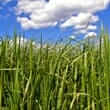
- Purple nutsedge (Cyperus rotundus) is a species of sedge (Cyperaceae family) native to Africa, southern and central Europe, and southern Asia. Sedges are a family of grass-like flowering plants. Purple nutsedge is considered an invasive weed in North America and is a common lawn weed. The therapeutic components of purple nutsedge are located in the tubers (a type of underground stem), which resemble nuts in appearance (hence the name nutsedge).
- Purple nutsedge has been used extensively in Asian therapies, especially Indian (Ayurvedic), Chinese, and Japanese (Kampo) traditions, to treat a wide variety of ailments, including bacterial infections, inflammation, and pain. In traditional medical systems in the Middle East, both fresh and dried forms of purple nutsedge have been used in a paste to heal skin wounds, ulcers, and sores.
- Modern research on purple nutsedge has investigated its possible antioxidant, antimicrobial, antidiabetic, and weight control effects. At this time, there is a lack of high-quality human trials supporting the efficacy of purple nutsedge for any indication.
Ingredients
Purple nutsedge (Cyperus rotundus)
Explore the available health information, treatment context, and integrative evidence for Purple nutsedge (Cyperus rotundus).
Evidence Ledger
Grades describe the evidence for Purple nutsedge (Cyperus rotundus) relative to each listed condition or goal.
Background
References
- Ardestani A, Yazdanparast R. Cyperus rotundus suppresses AGE formation and protein oxidation in a model of fructose-mediated protein glycoxidation. Int J Biol Macromol 12-1-2007;41(5):572-578.
View Abstract - Ha JH, Lee KY, Choi HC, et al. Modulation of radioligand binding to the GABA(A)-benzodiazepine receptor complex by a new component from Cyperus rotundus. Biol Pharm Bull 2002;25(1):128-130.
View Abstract - Kilani S, Ben Sghaier M, Limem I, et al. In vitro evaluation of antibacterial, antioxidant, cytotoxic and apoptotic activities of the tubers infusion and extracts of Cyperus rotundus. Bioresour Technol 2008;99(18):9004-9008.
View Abstract - Kilani S, Ledauphin J, Bouhlel I, et al. Comparative study of Cyperus rotundus essential oil by a modified GC/MS analysis method. Evaluation of its antioxidant, cytotoxic, and apoptotic effects. Chem Biodivers 2008;5(5):729-742.
View Abstract - Lemaure B, Touche, A, Zbinden I, et al. Administration of Cyperus rotundus tubers extract prevents weight gain in obese Zucker rats. Phytother.Res. 2007;21(8):724-730.
View Abstract - Makino T, Wakushima H, Okamoto T, et al. Effects of Kangen-karyu on coagulation system and platelet aggregation in mice. Biol Pharm Bull 2002;25(4):523-525.
View Abstract - Pal D, Dutta S, Sarkar A. Evaluation of CNS activities of ethanol extract of roots and rhizomes of Cyperus rotundus in mice. Acta Pol Pharm 2009;66(5):535-41.
View Abstract - Raut NA, Gaikwad NJ. Antidiabetic activity of hydro-ethanolic extract of Cyperus rotundus in alloxan induced diabetes in rats. Fitoterapia 2006;77(7-8):585-588.
View Abstract - Sayed HM, Mohamed MH, Farag SF, et al. Fructose-amino acid conjugate and other constituents from Cyperus rotundus L. Nat Prod Res 2008;22(17):1487-1497.
View Abstract - Sonwa MM, Konig WA. Chemical study of the essential oil of Cyperus rotundus. Phytochemistry 2001;58(5):799-810.
View Abstract - Thebtaranonth C, Thebtaranonth Y, Wanauppathamkul S, et al. Antimalarial sesquiterpenes from tubers of Cyperus rotundus: structure of 10,12-peroxycalamenene, a sesquiterpene endoperoxide. Phytochemistry 1995;40(1):125-128.
View Abstract - Uddin SJ, Mondal K, Shilpi JA, et al. Antidiarrhoeal activity of Cyperus rotundus. Fitoterapia 2006;77(2):134-136.
View Abstract - Xu Y, Zhang HW, Yu CY, et al. Norcyperone, a novel skeleton norsesquiterpene from Cyperus rotundus L Molecules 2008;13(10):2474-2481.
View Abstract - Yazdanparast R, Ardestani A. In vitro antioxidant and free radical scavenging activity of Cyperus rotundus. J Med Food 2007;10(4):667-674.
View Abstract - Yu HH, Lee, DH, Seo, SJ, et al. Anticariogenic properties of the extract of Cyperus rotundus. Am J Chin Med 2007;35(3):497-505.
View Abstract