
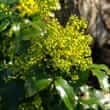
- Oregon grape (Mahonia aquifolium, Berberis aquifolium) is native to the west coast of North America, from British Columbia to northern California. It has yellow flowers, purple berries, and leathery leaves that resemble holly. It is not related to grape; however, the name Oregon grape originated from the purple clusters of berries that resemble grapes. It is a close relative of barberry (Berberis vulgaris).
- The rhizome, root, and bark, which are odorless and bitter, are collected in autumn to be used medicinally. Native Americans have traditionally used Oregon grape to treat various ailments, including digestive problems and inflammatory skin conditions. Studies in humans have shown that it may be effective against atopic dermatitis and psoriasis. Substances found in Oregon grape have been studied for their anticancer and antibacterial effects, although these uses are not well-studied in humans.
- Oregon grape is also used in food, landscaping, and dyes.
Ingredients
Oregon grape (Mahonia aquifolium, Berberis aquifolium)
Explore the available health information, treatment context, and integrative evidence for Oregon grape (Mahonia aquifolium, Berberis aquifolium).
Evidence Ledger
Grades describe the evidence for Oregon grape (Mahonia aquifolium, Berberis aquifolium) relative to each listed condition or goal.
Background
References
- Bernstein S, Donsky H, Gulliver W, et al. Treatment of mild to moderate psoriasis with Relieva, a Mahonia aquifolium extract--a double-blind, placebo-controlled study. Am J Ther 2006;13(2):121-126.
View Abstract - Donsky H and Clarke D. Relieva, a Mahonia aquifolium extract for the treatment of adult patients with atopic dermatitis. Am J Ther 2007;14(5):442-446.
View Abstract - Gulliver WP and Donsky HJ. A report on three recent clinical trials using Mahonia aquifolium 10% topical cream and a review of the worldwide clinical experience with Mahonia aquifolium for the treatment of plaque psoriasis. Am J Ther 2005;12(5):398-406.
View Abstract - Klovekorn W, Tepe A, and Danesch U. A randomized, double-blind, vehicle-controlled, half-side comparison with a herbal ointment containing Mahonia aquifolium, Viola tricolor and Centella asiatica for the treatment of mild-to-moderate atopic dermatitis. Int J Clin Pharmacol Ther 2007;45(11):583-591.
View Abstract - Rabbani GH, Butler T, Knight J, et al. Randomized controlled trial of berberine sulfate therapy for diarrhea due to enterotoxigenic Escherichia coli and Vibrio cholerae. J Infect Dis 1987;155(5):979-984.
View Abstract - Wu X, Li Q, Xin H, et al. Effects of berberine on the blood concentration of cyclosporin A in renal transplanted recipients: clinical and pharmacokinetic study. Eur J Clin Pharmacol 2005;61(8):567-572.
View Abstract