
- Mullein has been used in natural medicine for centuries and is among the oldest known medicinal plants. Mullein was brought to North America from Europe by settlers and was commonly used as a remedy for cough and diarrhea. It is found along roadsides, fields and barren areas in the United States.
- Traditionally, a poultice made from mullein leaves has been applied to the skin to treat ulcers and hemorrhoids. Mullein is typically used for inflammation in various areas of the body. The most commonly reported use is for respiratory tract conditions such as bronchitis and asthma, and also for ear pain associated with earaches. The proposed mechanism of action is by reducing the amount of mucous formation and as an expectorant.
- Currently, there are no available scientific studies (animal or human) that examine the efficacy of mullein alone. As of July 2006, the U. S. Food and Drug Administration (FDA) reported that mullein flowers (Verbascum phlomoides L. or V. thapsiforme Schrad.) are likely safe for use as natural flavoring substances and natural adjuvants in food in small amounts. However, mullein is categorized as a food additive for which a petition has been filed and a regulation issued. Further research is required before any recommendations can be made.
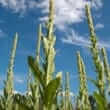
Ingredients
Mullein (Verbascum thapsus)
Explore the available health information, treatment context, and integrative evidence for Mullein (Verbascum thapsus).
Evidence Ledger
Grades describe the evidence for Mullein (Verbascum thapsus) relative to each listed condition or goal.
Background
References
- Abougazar H, Bedir E, Khan IA, et al. Wiedemanniosides A-E: new phenylethanoid glycosides from the roots of Verbascum wiedemannianum. Planta Med 2003;69(9):814-819.
View Abstract - Aligiannis N, Mitaku S, Tsitsa-Tsardis E, et al. Methanolic extract of Verbascum macrurum as a source of natural preservatives against oxidative rancidity. J Agric.Food Chem. 12-3-2003;51(25):7308-7312.
View Abstract - Bom I, van Wassenaar D, Boot J. Hybrid affinity chromatography of alpha-galactosidase from Verbascum thapsus L. J Chromatogr A 5-29-1998;808(1-2):133-139.
View Abstract - Klimek B. Hydroxycinnamoyl ester glycosides and saponins from flowers of Verbascum phlomoides. Phytochemistry 1996;43(6):1281-1284.
View Abstract - Lin LT, Liu LT, Chiang LC, et al. In vitro anti-hepatoma activity of fifteen natural medicines from Canada. Phytother Res 2002;16(5):440-444.
View Abstract - Magiatis P, Spanakis D, Mitaku S, et al. Verbalactone, a new macrocyclic dimer lactone from the roots of Verbascum undulatum with antibacterial activity. J Nat.Prod. 2001;64(8):1093-1094.
View Abstract - McCutcheon AR, Roberts TE, Gibbons E, et al. Antiviral screening of British Columbian medicinal plants. J Ethnopharmacol 12-1-1995;49(2):101-110.
View Abstract - Miyase T, Horikoshi C, Yabe S, et al. Saikosaponin homologues from Verbascum spp. The structures of mulleinsaponins I-VII. Chem Pharm Bull.(Tokyo) 1997;45(12):2029-2033.
View Abstract - Sarrell EM, Cohen HA, Kahan E. Naturopathic treatment for ear pain in children. Pediatrics 2003;111(5 Pt 1):e574-e579.
View Abstract - Sarrell EM, Mandelberg A, Cohen HA. Efficacy of naturopathic extracts in the management of ear pain associated with acute otitis media. Arch Pediatr Adolesc.Med 2001;155(7):796-799.
View Abstract - Serkedjieva J. Combined antiinfluenza virus activity of Flos verbasci infusion and amantadine derivatives. Phytother Res 2000;14(7):571-574.
View Abstract - Tadeg H, Mohammed E, Asres K, et al. Antimicrobial activities of some selected traditional Ethiopian medicinal plants used in the treatment of skin disorders. J Ethnopharmacol 8-22-2005;100(1-2):168-175.
View Abstract - Turker AU, Camper ND. Biological activity of common mullein, a medicinal plant. J Ethnopharmacol. 2002;82(2-3):117-125.
View Abstract - Zanon SM, Ceriatti FS, Rovera M, et al. Search for antiviral activity of certain medicinal plants from Cordoba, Argentina. Rev Latinoam.Microbiol. 1999;41(2):59-62.
View Abstract