
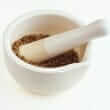
- Guar gum is an extract of the guar bean (Cyamopsis tetragonoloba). The plant is primarily grown in Pakistan and India. Guar gum is widely used as a food-thickening agent and as an ingredient in nutritional supplements.
- Guar gum is considered a plant-based dietary fiber, meaning that it is the edible part of a plant that may otherwise be hard to digest and absorb in the intestines. Dietary fibers may help promote bowel movements and may reduce cholesterol and blood sugar levels.
- There is much evidence supporting the use of guar gum in reducing cholesterol levels. Guar gum may help enhance the function of the gastrointestinal (GI) tract and may help people who have diarrhea, constipation, or irritable bowel syndrome (IBS). Studies have also shown that guar gum may lower blood sugar following meals, as well as insulin levels in people with and without diabetes.
- According to some research, guar gum may not be effective for weight loss. Following reports of side effects, the U.S. Food and Drug Administration (FDA) moved to ban guar gum as a weight loss ingredient.
- Commonly reported side effects associated with guar gum include stomach pain, diarrhea, and gassiness. Guar gum may also affect how the body absorbs drugs given at the same time, such as metformin and penicillin.
Ingredients
Guargum
Explore the available health information, treatment context, and integrative evidence for Guargum.
Evidence Ledger
Grades describe the evidence for Guargum relative to each listed condition or goal.
Background
References
- Alam, N. H., Meier, R., Sarker, S. A., Bardhan, P. K., Schneider, H., and Gyr, N. Partially hydrolysed guar gum supplemented comminuted chicken diet in persistent diarrhoea: a randomised controlled trial. Arch.Dis.Child 2005;90(2):195-199. View Abstract
- Alam, N. H., Meier, R., Schneider, H., Sarker, S. A., Bardhan, P. K., Mahalanabis, D., Fuchs, G. J., and Gyr, N. Partially hydrolyzed guar gum-supplemented oral rehydration solution in the treatment of acute diarrhea in children. J.Pediatr.Gastroenterol.Nutr. 2000;31(5):503-507. View Abstract
- Ebeling, P., Yki-Jarvinen, H., Aro, A., Helve, E., Sinisalo, M., and Koivisto, V. A. Glucose and lipid metabolism and insulin sensitivity in type 1 diabetes: the effect of guar gum. Am.J.Clin.Nutr. 1988;48(1):98-103. View Abstract
- Groop, P. H., Aro, A., Stenman, S., and Groop, L. Long-term effects of guar gum in subjects with non-insulin-dependent diabetes mellitus. Am.J.Clin.Nutr. 1993;58(4):513-518. View Abstract
- Gylling, H., Riikonen, S., Nikkila, K., Savonius, H., and Miettinen, T. A. Oral guar gum treatment of intrahepatic cholestasis and pruritus in pregnant women: effects on serum cholestanol and other non-cholesterol sterols. Eur.J.Clin.Invest 1998;28(5):359-363. View Abstract
- Halama, W. H. and Mauldin, J. L. Distal esophageal obstruction due to a guar gum preparation (Cal-Ban 3000). South.Med.J. 1992;85(6):642-645. View Abstract
- Harju, E., Heikkila, J., and Larmi, T. K. Effect of guar gum on gastric emptying after gastric resection. JPEN J.Parenter.Enteral Nutr. 1984;8(1):18-20. View Abstract
- Harju, E. and Larmi, T. K. Efficacy of guar gum in preventing the dumping syndrome. JPEN J.Parenter.Enteral Nutr. 1983;7(5):470-472. View Abstract
- Hunninghake, D. B., Miller, V. T., LaRosa, J. C., Kinosian, B., Jacobson, T., Brown, V., Howard, W. J., Edelman, D. A., and O'Connor, R. R. Long-term treatment of hypercholesterolemia with dietary fiber. Am.J.Med. 1994;97(6):504-508. View Abstract
- Knopp, R. H., Superko, H. R., Davidson, M., Insull, W., Dujovne, C. A., Kwiterovich, P. O., Zavoral, J. H., Graham, K., O'Connor, R. R., and Edelman, D. A. Long-term blood cholesterol-lowering effects of a dietary fiber supplement. Am.J.Prev.Med. 1999;17(1):18-23. View Abstract
- Lewis, J. H. Esophageal and small bowel obstruction from guar gum-containing "diet pills": analysis of 26 cases reported to the Food and Drug Administration. Am.J.Gastroenterol. 1992;87(10):1424-1428. View Abstract
- Pittler, M. H. and Ernst, E. Guar gum for body weight reduction: meta-analysis of randomized trials. Am.J.Med. 6-15-2001;110(9):724-730. View Abstract
- Riikonen, S., Savonius, H., Gylling, H., Nikkila, K., Tuomi, A. M., and Miettinen, T. A. Oral guar gum, a gel-forming dietary fiber relieves pruritus in intrahepatic cholestasis of pregnancy. Acta Obstet.Gynecol.Scand. 2000;79(4):260-264. View Abstract
- Salenius, J. P., Harju, E., Jokela, H., Riekkinen, H., and Silvasti, M. Long term effects of guar gum on lipid metabolism after carotid endarterectomy. BMJ 1-14-1995;310(6972):95-96. View Abstract
- Vuorinen-Markkola, H., Sinisalo, M., and Koivisto, V. A. Guar gum in insulin-dependent diabetes: effects on glycemic control and serum lipoproteins. Am.J.Clin.Nutr. 1992;56(6):1056-1060. View Abstract