
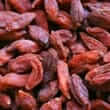
- The dried ripe fruits of Lycium barbarum and Lycium chinense, commonly called goji berry or wolfberry, have been consumed for medicinal purposes and as a functional food in China and throughout Asia for at least 2,000 years. Traditionally, goji berry has been used for its antiaging properties, vision-enhancing and immune system-enhancing effects, and support of kidney and liver function, and as a treatment for respiratory diseases. Goji berries contain significant quantities of lutein and zeaxanthin, which are antioxidant carotenoid pigments. The leaves, roots, and root bark of Lycium species have also been used medicinally.
- China is the world's main supplier of commercially grown goji berries. In the 21st Century, goji berries and juice have become increasingly popular "superfoods" in the Western world.
- Although not well-studied in humans, Lycium barbarum polysaccharides (LBP) have demonstrated anticancer, antidiabetic, anti-infertility, antioxidant, blood pressure-lowering, cholesterol-lowering, and immune-stimulating properties. More human clinical studies are needed to investigate goji's potential therapeutic effects.
Ingredients
Goji (Lycium spp.)
Explore the available health information, treatment context, and integrative evidence for Goji (Lycium spp.).
Evidence Ledger
Grades describe the evidence for Goji (Lycium spp.) relative to each listed condition or goal.
Background
References
Natural Standard developed the above evidence-based information based on a thorough systematic review of the available scientific articles. For comprehensive information about alternative and complementary therapies on the professional level, go to . Selected references are listed below.
- Benzie IF, Chung WY, Wang J, et al. Enhanced bioavailability of zeaxanthin in a milk-based formulation of wolfberry (Gou Qi Zi; Fructus barbarum L.). Br J Nutr 2006;96(1):154-160.
View Abstract - Breithaupt DE, Weller P, Wolters M, et al. Comparison of plasma responses in human subjects after the ingestion of 3R,3R'-zeaxanthin dipalmitate from wolfberry (Lycium barbarum) and non-esterified 3R,3R'-zeaxanthin using chiral high-performance liquid chromatography. Br J Nutr 2004;91(5):707-713.
View Abstract - Cao GW, Yang WG, Du, P. [Observation of the effects of LAK/IL-2 therapy combining with Lycium barbarum polysaccharides in the treatment of 75 cancer patients]. Zhonghua Zhong Liu Za Zhi 1994;16(6):428-431.
View Abstract - Cheng CY, Chung WY, Szeto YT, et al. Fasting plasma zeaxanthin response to Fructus barbarum L. (wolfberry; Kei Tze) in a food-based human supplementation trial. Br J Nutr 2005;93(1):123-130.
View Abstract - Fu JX. [Measurement of MEFV in 66 cases of asthma in the convalescent stage and after treatment with Chinese herbs]. Zhong Xi Yi Jie He Za Zhi 1989;9(11):658-9, 644.
View Abstract - Gan L, Hua Zhang S, Liang Yang X, et al. Immunomodulation and antitumor activity by a polysaccharide-protein complex from Lycium barbarum. Int Immunopharmacol 2004;4(4):563-569.
View Abstract - Gan L, Zhang SH, Liu Q, et al. A polysaccharide-protein complex from Lycium barbarum upregulates cytokine expression in human peripheral blood mononuclear cells. Eur J Pharmacol 2003;471(3):217-222.
View Abstract - Gong H, Shen P, Jin L, et al. Therapeutic effects of Lycium barbarum polysaccharide (LBP) on irradiation or chemotherapy-induced myelosuppressive mice. Cancer Biother Radiopharm 2005;20(2):155-162.
View Abstract - Kim HP, Kim SY, Lee EJ, et al. Zeaxanthin dipalmitate from Lycium chinense has hepatoprotective activity. Res Commun Mol Pathol Pharmacol 1997;97(3):301-314.
View Abstract - Lee DG, Jung HJ, Woo ER. Antimicrobial property of (+)-lyoniresinol-3alpha-O-beta-D-glucopyranoside isolated from the root bark of Lycium chinense Miller against human pathogenic microorganisms. Arch Pharm Res 2005;28(9):1031-1036.
View Abstract - Luo Q, Li Z, Huang X, et al. Lycium barbarum polysaccharides: Protective effects against heat-induced damage of rat testes and H2O2-induced DNA damage in mouse testicular cells and beneficial effect on sexual behavior and reproductive function of hemicastrated rats. Life Sci 2006;79(7):613-621.
View Abstract - Luo Q, Cai Y, Yan J, et al. Hypoglycemic and hypolipidemic effects and antioxidant activity of fruit extracts from Lycium barbarum. Life Sci 2004;76(2):137-149.
View Abstract - Wu H, Guo H, Zhao R. Effect of Lycium barbarum polysaccharide on the improvement of antioxidant ability and DNA damage in NIDDM rats. Yakugaku Zasshi 2006;126(5):365-371.
View Abstract - Yu MS, Leung SK, Lai SW, et al. Neuroprotective effects of anti-aging oriental medicine Lycium barbarum against beta-amyloid peptide neurotoxicity. Exp Gerontol 2005;40(8-9):716-727.
View Abstract - Zhao R, Li Q, Xiao B. Effect of Lycium barbarum polysaccharide on the improvement of insulin resistance in NIDDM rats. Yakugaku Zasshi 2005;125(12):981-988.
View Abstract