
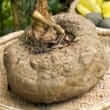
- Native to Asia, the konjac plant (Amorphophallus konjac) is characterized by its heavy tubers (10 pounds or more in weight) and blotchy, snakeskin-patterned stem. It is most known as a source of glucomannan, a soluble, fermentable, and highly viscous dietary fiber derived from the roots of the plant.
- The konjac plant has been used as a source of both food and medicine in traditional Asian practices for more than a thousand years. More recently, glucomannan extracts derived from the konjac plant have been used as a dietary supplement or as a source of mannose, a sugar substitute in food products.
- Given the highly viscous nature of glucomannan fiber, it effectively absorbs water in the digestive tract and decreases the absorption of carbohydrates and cholesterol. As such, since the 1980s, Western medicinal practices have valued glucomannan for its potential to reduce cholesterol levels, constipation, blood sugar, and weight. It has also been explored as a component of artificial skin products, and in the treatment of high blood pressure and hyperthyroidism (overactive thyroid), though additional research in these areas is needed.
Ingredients
Glucomannan
Explore the available health information, treatment context, and integrative evidence for Glucomannan.
Evidence Ledger
Grades describe the evidence for Glucomannan relative to each listed condition or goal.
Background
References
- Arvill A, Bodin L. Effect of short-term ingestion of konjac glucomannan on serum cholesterol in healthy men. Am J Clin Nutr 1995;61(3):585-589. View Abstract
- Azezli AD, Bayraktaroglu T, Orhan Y. The use of konjac glucomannan to lower serum thyroid hormones in hyperthyroidism. J Am Coll Nutr 2007;26(6):663-668. View Abstract
- Chearskul S, Kriengsinyos W, Kooptiwut S, et al. Immediate and long-term effects of glucomannan on total ghrelin and leptin in type 2 diabetes mellitus. Diabetes Res Clin Pract 2009;83(2):e40-e42. View Abstract
- Chen HL, Cheng HC, Liu YJ, et al. Konjac acts as a natural laxative by increasing stool bulk and improving colonic ecology in healthy adults. Nutrition 2006;22(11-12):1112-1119. View Abstract
- Chen HL, Cheng HC, Wu WT, et al. Supplementation of konjac glucomannan into a low-fiber Chinese diet promoted bowel movement and improved colonic ecology in constipated adults: a placebo-controlled, diet-controlled trial. J Am Coll Nutr 2008;27(1):102-108. View Abstract
- Chen HL, Sheu WH, Tai TS, et al. Konjac supplement alleviated hypercholesterolemia and hyperglycemia in type 2 diabetic subjects--a randomized double-blind trial. J Am Coll Nutr 2003;22(1):36-42. View Abstract
- Gonzalez CA, Fernandez MN, Sahagun AM, et al. Glucomannan: properties and therapeutic applications. Nutr Hosp 2004;19(1):45-50. View Abstract
- Keithley J, Swanson B. Glucomannan and obesity: a critical review. Altern Ther Health Med 2005;11(6):30-34. View Abstract
- Loening-Baucke V, Miele E, Staiano A. Fiber (glucomannan) is beneficial in the treatment of childhood constipation. Pediatrics 2004;113(3 Pt 1):e259-e264. View Abstract
- Martino F, Martino E, Morrone F, et al. Effect of dietary supplementation with glucomannan on plasma total cholesterol and low density lipoprotein cholesterol in hypercholesterolemic children. Nutr Metab Cardiovasc Dis 2005;15(3):174-180. View Abstract
- Salas-Salvado J, Farres X, Luque X, et al. Effect of two doses of a mixture of soluble fibres on body weight and metabolic variables in overweight or obese patients: a randomised trial. Br J Nutr 2008;99(6):1380-1387. View Abstract
- Sood N, Baker WL, Coleman CI. Effect of glucomannan on plasma lipid and glucose concentrations, body weight, and blood pressure: systematic review and meta-analysis. Am J Clin Nutr 2008;88(4):1167-1175. View Abstract
- Vido L, Facchin P, Antonello I, et al. Childhood obesity treatment: double blinded trial on dietary fibres (glucomannan) versus placebo. Padiatr Padol 1993;28(5):133-136. View Abstract
- Vuksan V, Jenkins DJ, Spadafora P, et al. Konjac-mannan (glucomannan) improves glycemia and other associated risk factors for coronary heart disease in type 2 diabetes. A randomized controlled metabolic trial. Diabetes Care 1999;22(6):913-919. View Abstract
- Vuksan V, Sievenpiper JL, Owen R, et al. Beneficial effects of viscous dietary fiber from Konjac-mannan in subjects with the insulin resistance syndrome: results of a controlled metabolic trial. Diabetes Care 2000;23(1):9-14. View Abstract