
- Comfrey (Symphytum spp.) is native to both Europe and Asia and has traditionally been used as both a food and forage crop. Three plant species in the genus Symphytum are medicinally relevant and include wild or common comfrey (Symphytum officinale L.), prickly or rough comfrey [Symphytum asperum Lepechin (Symphytum asperrimum Donn)], and Caucasian, Quaker, Russian, or blue comfrey [Symphytum × uplandicum Nyman (Symphytum peregrinum Lebed.)], which originated as a natural hybrid of Symphytum officinale L. and Symphytum asperum Lepechin.
- Comfrey has traditionally been both applied to the skin (topically) for inflammation, pain and wound healing, and taken by mouth (orally) for gastrointestinal, respiratory and gynecological concerns.
- Although evidence supporting oral use of comfrey is lacking, clinical trials suggest topical comfrey may be advantageous for pain and inflammation associated with injuries.
- Although comfrey has been traditionally used both orally and topically, recent evidence suggesting carcinogenic and hepatotoxic effects has led to withdrawal of oral products from the market in many countries and warnings to avoid use on open wounds.
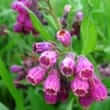
Ingredients
Comfrey (Symphytum spp.)
Explore the available health information, treatment context, and integrative evidence for Comfrey (Symphytum spp.).
Evidence Ledger
Grades describe the evidence for Comfrey (Symphytum spp.) relative to each listed condition or goal.
Background
References
Natural Standard developed the above evidence-based information based on a thorough systematic review of the available scientific articles. For comprehensive information about alternative and complementary therapies on the professional level, go to . Selected references are listed below.
- Altamirano JC, Gratz SR, Wolnik KA. Investigation of pyrrolizidine alkaloids and their N-oxides in commercial comfrey-containing products and botanical materials by liquid chromatography electrospray ionization mass spectrometry. J AOAC Int 2005;88(2):406-412.
View Abstract - Barbakadze VV, Kemertelidze EP, Targamadze IL, et al. [Novel biologically active polymer of 3-(3,4-dihydroxyphenyl)glyceric acid from two types of the comphrey Symphytum asperum and S. caucasicvum (Boraginoceae)]. Bioorg.Khim. 2002;28(4):362-366.
View Abstract - Barthomeuf CM, Debiton E, Barbakadze VV, et al. Evaluation of the dietetic and therapeutic potential of a high molecular weight hydroxycinnamate-derived polymer from Symphytum asperum Lepech. Regarding its antioxidant, antilipoperoxidant, antiinflammatory, and cytotoxic properties. J Agric.Food Chem 2001;49(8):3942-3946.
View Abstract - Dasgupta A. Review of abnormal laboratory test results and toxic effects due to use of herbal medicines. Am J Clin Pathol 2003;120(1):127-137.
View Abstract - Di Mambro VM, Fonseca MJ. Assays of physical stability and antioxidant activity of a topical formulation added with different plant extracts. J Pharm Biomed Anal. 2-23-2005;37(2):287-295.
View Abstract - Gray DE, Porter A, O'Neill T, et al. A rapid cleanup method for the isolation and concentration of pyrrolizidine alkaloids in comfrey root. J AOAC Int 2004;87(5):1049-1057.
View Abstract - Karavaev VA, Solntsev MK, Iurina TP, et al. [Antifungal activity of aqueous extracts from the leaf of cowparsnip and comfrey]. Izv.Akad.Nauk Ser.Biol 2001;(4):435-441.
View Abstract - Koll R, Buhr M, Dieter R, et al. Efficacy and tolerance of a comfrey root extract (Extr. Rad. Symphyti) in the treatment of ankle distorsions: results of a multicenter, randomized, placebo-controlled, double-blind study. Phytomedicine. 2004;11(6):470-477.
View Abstract - Kucera M, Barna M, Horacek O, et al. Topical symphytum herb concentrate cream against myalgia: a randomized controlled double-blind clinical study. Adv Ther 2005;22(6):681-692.
View Abstract - Kucera M, Barna M, Horacek O, et al. Efficacy and safety of topically applied Symphytum herb extract cream in the treatment of ankle distortion: results of a randomized controlled clinical double blind study. Wien.Med Wochenschr. 2004;154(21-22):498-507.
View Abstract - Mei N, Guo L, Fu PP, et al. Mutagenicity of comfrey (Symphytum Officinale) in rat liver. Br J Cancer 3-14-2005;92(5):873-875.
View Abstract - Oberlies NH, Kim NC, Brine DR, et al. Analysis of herbal teas made from the leaves of comfrey (Symphytum officinale): reduction of N-oxides results in order of magnitude increases in the measurable concentration of pyrrolizidine alkaloids. Public Health Nutr 2004;7(7):919-924.
View Abstract - Predel HG, Giannetti B, Koll R, et al. Efficacy of a comfrey root extract ointment in comparison to a diclofenac gel in the treatment of ankle distortions: results of an observer-blind, randomized, multicenter study. Phytomedicine 2005;12(10):707-714.
View Abstract - Schaneberg BT, Molyneux RJ, Khan IA. Evaporative light scattering detection of pyrrolizidine alkaloids. Phytochem.Anal. 2004;15(1):36-39.
View Abstract - Thornfeldt C. Cosmeceuticals containing herbs: fact, fiction, and future. Dermatol Surg. 2005;31(7 Pt 2):873-880.
View Abstract