
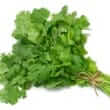
- Coriander (Coriandrum sativum) is an annual herb in the Apiaceae family. The leaves are also referred to as "coriander leaves," "Chinese parsley," or "cilantro" (from Spanish) in the Americas. "Coriander" also refers to the spice produced from coriander seeds.
- Known for its strong flavor, cilantro is often used in Mexican, Asian, and Caribbean cooking. Recipes that specifically call for "fresh coriander" are referring to the leaves (cilantro). Both coriander and cilantro are commonly used in soups, salads, dressings, salsa, and chutney. The leaves are used in curry and guacamole.
- There is some evidence that Coriandrum sativum may improve vision, digestion, and blood sugar and cholesterol levels. Clinical studies have been done testing the use of cilantro to treat antibiotic-resistant bacterial infections and irritable bowel syndrome. It has also been used to treat mercury poisoning. However, better-designed clinical trials are needed before conclusions can be made regarding the effectiveness of cilantro for any condition.
- Chinese herbal medicine uses cilantro and coriander for measles, stomachache, and nausea. It is traditionally used as a home remedy for heat stroke, high blood sugar, and hemorrhoids. Some studies suggest that coriander juice mixed with turmeric powder or mint juice may be used as a treatment for acne.
- The flavor of cilantro has been described as a mix of parsley and citrus. Coriander is popular in Indian curries, spice mixtures, and tea infusions. Coriander oil is used for its antibacterial effects and as a natural fragrance in perfumes, soaps, and other cosmetics
Ingredients
Cilantro
Explore the available health information, treatment context, and integrative evidence for Cilantro.
Evidence Ledger
Grades describe the evidence for Cilantro relative to each listed condition or goal.
Background
References
- Chowdhury, B. R., Chakraborty, R., and Raychaudhuri, U. Study on beta-galactosidase enzymatic activity of herbal yogurt. Int.J Food Sci.Nutr. 2008;59(2):116-122. View Abstract
- Cloyd, R. A., Galle, C. L., Keith, S. R., Kalscheur, N. A., and Kemp, K. E. Effect of commercially available plant-derived essential oil products on arthropod pests. J Econ.Entomol. 2009;102(4):1567-1579. View Abstract
- Fan, X. and Sokorai, K. J. Changes in volatile compounds of gamma-irradiated fresh cilantro leaves during cold storage. J Agric.Food Chem. 12-18-2002;50(26):7622-7626. View Abstract
- Fan, X. and Sokorai, K. J. Retention of quality and nutritional value of 13 fresh-cut vegetables treated with low-dose radiation. J Food Sci. 2008;73(7):S367-S372. View Abstract
- Foley, D., Euper, M., Caporaso, F., and Prakash, A. Irradiation and chlorination effectively reduces Escherichia coli O157:H7 inoculated on cilantro (Coriandrum sativum) without negatively affecting quality. J Food Prot. 2004;67(10):2092-2098. View Abstract
- Garcia-Gonzalez, J. J., Bartolome-Zavala, B., Fernandez-Melendez, S., Barcelo-Munoz, J. M., Miranda, Paez A., Carmona-Bueno, M. J., Vega-Chicote, J. M., Negro Carrasco, M. A., Ameal, Godoy A., and Pamies, Espinosa R. Occupational rhinoconjunctivitis and food allergy because of aniseed sensitization. Ann.Allergy Asthma Immunol. 2002;88(5):518-522. View Abstract
- Gray, A. M. and Flatt, P. R. Insulin-releasing and insulin-like activity of the traditional anti-diabetic plant Coriandrum sativum (coriander). Br.J Nutr. 1999;81(3):203-209. View Abstract
- Jabeen, Q., Bashir, S., Lyoussi, B., and Gilani, A. H. Coriander fruit exhibits gut modulatory, blood pressure lowering and diuretic activities. J Ethnopharmacol. 2-25-2009;122(1):123-130. View Abstract
- Moneret-Vautrin, D. A., Morisset, M., Lemerdy, P., Croizier, A., and Kanny, G. Food allergy and IgE sensitization caused by spices: CICBAA data (based on 589 cases of food allergy). Allerg.Immunol.(Paris) 2002;34(4):135-140. View Abstract
- Niinimaki, A., Hannuksela, M., and Makinen-Kiljunen, S. Skin prick tests and in vitro immunoassays with native spices and spice extracts. Ann Allergy Asthma Immunol. 1995;75(3):280-286. View Abstract
- van Toorenenbergen, A. W., Huijskes-Heins, M. I., Leijnse, B., and Dieges, P. H. Immunoblot analysis of IgE-binding antigens in spices. Int Arch Allergy Appl.Immunol. 1988;86(1):117-120. View Abstract
- Punna, R. and Rao, Paruchuri U. Effect of maturity and processing on total, insoluble and soluble dietary fiber contents of Indian green leafy vegetables. Int J Food Sci Nutr. 2004;55(7):561-567. View Abstract
- Srinivasan, K. Plant foods in the management of diabetes mellitus: spices as beneficial antidiabetic food adjuncts. Int.J Food Sci.Nutr. 2005;56(6):399-414. View Abstract
- Suneetha WJ, Krishnakantha TP. Antiplatelet activity of coriander and curry leaf spices. Pharmaceutical Biology 2005;43(3):230-233.
- Tarwadi, K. and Agte, V. Potential of commonly consumed green leafy vegetables for their antioxidant capacity and its linkage with the micronutrient profile. Int J Food Sci Nutr. 2003;54(6):417-425. View Abstract