
- Wild celery can be found throughout Europe, the Mediterranean, and parts of Asia. The leaves, stalks, root, and seeds can be eaten. In western cuisine, the stalks of its domesticated cousin are commonly used in cooking and may be eaten raw alone or in salads, or as a cooked ingredient in various recipes. Celery seed has also been used as a diuretic (increase urine flow) and to treat gout (foot inflammation). However, there is insufficient evidence in humans to support the use of celery for any indication.
- Allergy to celery is fairly common, as celery contains an allergen similar to the birch pollen allergen. Both raw and cooked celery can cause reactions that range from contact dermatitis to anaphylactic shock.
- The ancient Greeks and Egyptians cultivated celery, which was probably originally used as a medicine. Some Egyptian tombs also contained celery leaves and flowers.
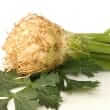
Ingredients
Celery (Apium graveolens)
Explore the available health information, treatment context, and integrative evidence for Celery (Apium graveolens).
Evidence Ledger
Grades describe the evidence for Celery (Apium graveolens) relative to each listed condition or goal.
Background
References
- Asero R, Mistrello G, Roncarolo D, et al. Immunological cross-reactivity between lipid transfer proteins from botanically unrelated plant-derived foods: a clinical study. Allergy 2002;57(10):900-906.
View Abstract - Ballmer-Weber BK, Hoffmann A, Wuthrich B, et al. Influence of food processing on the allergenicity of celery: DBPCFC with celery spice and cooked celery in patients with celery allergy. Allergy 2002;57(3):228-235.
View Abstract - Bant A, Kruszewski J, Droszcz W, et al. [Hypersensitivity to poppy seeds]. Wiad.Lek. 2005;58(7-8):447-450.
View Abstract - Chu YF, Sun J, Wu X, et al. Antioxidant and antiproliferative activities of common vegetables. J Agric.Food Chem 11-6-2002;50(23):6910-6916.
View Abstract - Darsow U, Laifaoui J, Kerschenlohr K, et al. The prevalence of positive reactions in the atopy patch test with aeroallergens and food allergens in subjects with atopic eczema: a European multicenter study. Allergy 2004;59(12):1318-1325.
View Abstract - DeLeo VA. Photocontact dermatitis. Dermatol Ther 2004;17(4):279-288.
View Abstract - Erdmann SM, Sachs B, Schmidt A, et al. In vitro analysis of birch-pollen-associated food allergy by use of recombinant allergens in the basophil activation test. Int Arch Allergy Immunol 2005;136(3):230-238.
View Abstract - Jahn-Schmid B, Radakovics A, Luttkopf D, et al. Bet v 1142-156 is the dominant T-cell epitope of the major birch pollen allergen and important for cross-reactivity with Bet v 1-related food allergens. J Allergy Clin Immunol 2005;116(1):213-219.
View Abstract - Jeanmougin M, Varroud-Vial C, Dubertret L. [Phototoxic side-effect following celery ingestion during puvatherapy]. Ann.Dermatol Venereol 2005;132(6-7 Pt 1):566-567.
View Abstract - Kurzen M, Bayerl C, Goerdt S. [Occupational allergy to mugwort]. J Dtsch.Dermatol Ges 2003;1(4):285-290.
View Abstract - Moneret-Vautrin DA, Morisset M, Lemerdy P, et al. Food allergy and IgE sensitization caused by spices: CICBAA data (based on 589 cases of food allergy). Allerg.Immunol (Paris) 2002;34(4):135-140.
View Abstract - Moreno-Ancillo A, Gil-Adrados AC, Dominguez-Noche C, et al. Occupational asthma due to carrot in a cook. Allergol.Immunopathol.(Madr.) 2005;33(5):288-290.
View Abstract - Sausenthaler S, Koletzko S, Schaaf B, et al. Maternal diet during pregnancy in relation to eczema and allergic sensitization in the offspring at 2 y of age. Am J Clin Nutr 2007;85(2):530-537.
View Abstract - Tuetun B, Choochote W, Kanjanapothi D, et al. Repellent properties of celery, Apium graveolens L., compared with commercial repellents, against mosquitoes under laboratory and field conditions. Trop.Med Int Health 2005;10(11):1190-1198.
View Abstract - Wang L, Sterling B, Don P. Berloque dermatitis induced by "Florida water". Cutis 2002;70(1):29-30.
View Abstract