
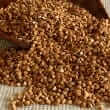
- Buckwheat was originally grown in Asia but is now also grown in North America. It has likely been grown in China since approximately 1000 BC. Buckwheat is not a cereal but a gluten-free knot grass. Buckwheat flowers are smooth-textured and white to light pink, and they bloom from midsummer to early fall. Buckwheat seeds ripen from August to October.
- Buckwheat flour is used in cereal, pancakes, noodles, and bread. Other traditionally consumed parts of the plant include raw or cooked buckwheat leaves, raw or cooked seeds, and sprouted seeds. The grain can also be used to brew beer.
- Nutritionally, buckwheat is of interest because of its protein, fiber, and fatty acid composition and its gluten-free nature. Also, buckwheat consumption is associated with beneficial levels of cardiovascular disease risk factors. Buckwheat is also a source of dietary flavonoids, such as rutin and quercetin, which may offer health benefits.
- Clinical trials suggest that buckwheat consumption may help reduce leg volume in individuals with chronic venous insufficiency and help treat symptoms of diabetic retinopathy. However, more evidence is required in these and other areas, including its proposed blood sugar-lowering and cholesterol-lowering effects.
Ingredients
Buckwheat
Explore the available health information, treatment context, and integrative evidence for Buckwheat.
Evidence Ledger
Grades describe the evidence for Buckwheat relative to each listed condition or goal.
Background
References
- Archimowicz-Cyrylowska B, Adamek B, Droździk M, et al. Clinical effect of buckwheat herb, Ruscus extract and troxerutin on retinopathy and lipids in diabetic patients. Phytother Res 1996;10(8):659-662.
- Bijlani RL, Sud S, Sahi A, et al. Effect of sieved buckwheat (Fagopyrum esculentum) flour supplementation on lipid profile and glucose tolerance. Indian J Physiol Pharmacol 1985;29(2):69-74. View Abstract
- di Cagno R, de Angelis M, Alfonsi G, et al. Pasta made from durum wheat semolina fermented with selected lactobacilli as a tool for a potential decrease of the gluten intolerance. J Agric Food Chem 2005;53(11):4393-4402. View Abstract
- Fritz SB, Gold BL. Buckwheat pillow-induced asthma and allergic rhinitis. Ann Allergy Asthma Immunol 2003;90(3):355-358. View Abstract
- Gheldof N, Wang XH, Engeseth NJ. Buckwheat honey increases serum antioxidant capacity in humans. J Agric Food Chem 2003;51(5):1500-1505. View Abstract
- Graefe EU, Wittig J, Mueller S,et al. Pharmacokinetics and bioavailability of quercetin glycosides in humans. J Clin Pharmacol 2001;41(5):492-499. View Abstract
- Ihme N, Kiesewetter H, Jung, Fet al. Leg oedema protection from a buckwheat herb tea in patients with chronic venous insufficiency: a single-centre, randomised, double-blind, placebo-controlled clinical trial. Eur J Clin Pharmacol 1996;50(6):443-447. View Abstract
- Lee SY, Lee KS, Hong CH,et al. Three cases of childhood nocturnal asthma due to buckwheat allergy. Allergy 2001;56(8):763-766. View Abstract
- Leynadier F. [Anaphylaxis. 3 clinical cases]. Allerg Immunol (Paris ) 2001;33(10):409-411. View Abstract
- Park SS, Ohba H. Suppressive activity of protease inhibitors from buckwheat seeds against human T-acute lymphoblastic leukemia cell lines. Appl Biochem Biotechnol 2004;117(2):65-74. View Abstract
- Plaza T, Mahler V. [Anaphylactic shock due to French galette. Type I allergic reaction to buckwheat]. Hautarzt 2005;56(2):160-163. View Abstract
- Stember RH. Buckwheat allergy. Allergy Asthma Proc 2006;27(4):393-395. View Abstract
- Tanaka H, Tanio S, Hoshina T, et al. [Epidemiological and bacteriological investigation of enterohemorrhagic Escherichia coli infection in the Chugoku-Shikoku area]. Kansenshogaku Zasshi 2002;76(6):439-449. View Abstract
- Tanaka K, Matsumoto K, Akasawa A, et al. Pepsin-resistant 16-kD buckwheat protein is associated with immediate hypersensitivity reaction in patients with buckwheat allergy. Int Arch Allergy Immunol 2002;129(1):49-56. View Abstract
- Zhang HW, Zhang YH, Lu MJ, et al. Comparison of hypertension, dyslipidaemia and hyperglycaemia between buckwheat seed-consuming and non-consuming Mongolian-Chinese populations in Inner Mongolia, China. Clin Exp Pharmacol Physiol 2007;34(9):838-844. View Abstract