
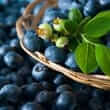
- Blueberries are native to North America but are now grown around the world. Native Americans ate blueberries, and by drying them in the sun and sometimes pulverizing them, they were able to use them throughout the year. In addition to the fruit, blueberry roots and leaves were also used in teas, particularly to help women relax during childbirth. Native Americans introduced Europeans to this fruit.
- Blueberries have high antioxidant levels due to the presence of anthocyanins, which are the pigments many plants produce to attract the birds and insects necessary for pollination. Lowbush (wild) blueberries have higher levels of certain antioxidant compounds than highbush varieties.
- In addition to antioxidant properties, limited research suggests that blueberries may also provide anti-inflammatory effects and help maintain the health of the brain. Also, according to limited studies, Blueberinâ„¢, which contains extract from blueberry plants and components from bayberry, as well as a combination of blueberry and sea buckthorn, may help manage diabetes. At this time, however, there is a lack of human evidence in support of any clinical use of blueberries. Further research is required.
Ingredients
Blueberry
Explore the available health information, treatment context, and integrative evidence for Blueberry.
Evidence Ledger
Grades describe the evidence for Blueberry relative to each listed condition or goal.
Background
References
- Gebhardt, C., Vieths, S., Gubesch, M., Averbeck, M., Simon, J. C., and Treudler, R. 10 kDa lipid transfer protein: the main allergenic structure in a German patient with anaphylaxis to blueberry. Allergy 2009;64(3):498-499. View Abstract
- Hilliard, J. J., Krause, H. M., Bernstein, J. I., Fernandez, J. A., Nguyen, V., Ohemeng, K. A., and Barrett, J. F. A comparison of active site binding of 4-quinolones and novel flavone gyrase inhibitors to DNA gyrase. Adv Exp Med Biol 1995;390:59-69. View Abstract
- Joseph, J. A., Denisova, N. A., Arendash, G., Gordon, M., Diamond, D., Shukitt-Hale, B., and Morgan, D. Blueberry supplementation enhances signaling and prevents behavioral deficits in an Alzheimer disease model. Nutr Neurosci. 2003;6(3):153-162. View Abstract
- Joseph, J. A., Neuman, A., Bielinski, D. F., and Fisher, D. R. Blueberry antagonism of C-2 ceramide disruption of Ca2+ responses and recovery in MAChR-transfected COS-7 cell. J Alzheimers.Dis 2008;15(3):429-441. View Abstract
- Kalt, W., Ryan, D. A., Duy, J. C., Prior, R. L., Ehlenfeldt, M. K., and Vander Kloet, S. P. Interspecific variation in anthocyanins, phenolics, and antioxidant capacity among genotypes of highbush and lowbush blueberries (Vaccinium section cyanococcus spp.). J Agric.Food Chem 2001;49(10):4761-4767. View Abstract
- Kay, C. D. and Holub, B. J. The effect of wild blueberry (Vaccinium angustifolium) consumption on postprandial serum antioxidant status in human subjects. Br.J.Nutr. 2002;88(4):389-398. View Abstract
- Martineau, L. C., Couture, A., Spoor, D., Benhaddou-Andaloussi, A., Harris, C., Meddah, B., Leduc, C., Burt, A., Vuong, T., Mai, Le P., Prentki, M., Bennett, S. A., Arnason, J. T., and Haddad, P. S. Anti-diabetic properties of the Canadian lowbush blueberry Vaccinium angustifolium Ait. Phytomedicine. 2006;13(9-10):612-623. View Abstract
- Marzban, G., Mansfeld, A., Hemmer, W., Stoyanova, E., Katinger, H., and da Camara Machado, M. L. Fruit cross-reactive allergens: a theme of uprising interest for consumers' health. Biofactors 2005;23(4):235-241. View Abstract
- Pedersen, C. B., Kyle, J., Jenkinson, A. M., Gardner, P. T., McPhail, D. B., and Duthie, G. G. Effects of blueberry and cranberry juice consumption on the plasma antioxidant capacity of healthy female volunteers. Eur.J.Clin.Nutr. 2000;54(5):405-408. View Abstract
- Prior, R. L., Gu, L., Wu, X., Jacob, R. A., Sotoudeh, G., Kader, A. A., and Cook, R. A. Plasma antioxidant capacity changes following a meal as a measure of the ability of a food to alter in vivo antioxidant status. J Am Coll Nutr 2007;26(2):170-181. View Abstract
- Puupponen-Pimia, R., Nohynek, L., Hartmann-Schmidlin, S., Kahkonen, M., Heinonen, M., Maatta-Riihinen, K., and Oksman-Caldentey, K. M. Berry phenolics selectively inhibit the growth of intestinal pathogens. J Appl Microbiol. 2005;98(4):991-1000. View Abstract
- Rimando, A. M., Nagmani, R., Feller, D. R., and Yokoyama, W. Pterostilbene, a new agonist for the peroxisome proliferator-activated receptor alpha-isoform, lowers plasma lipoproteins and cholesterol in hypercholesterolemic hamsters. J Agric.Food Chem 5-4-2005;53(9):3403-3407. View Abstract
- Shukitt-Hale, B., Lau, F. C., Carey, A. N., Galli, R. L., Spangler, E. L., Ingram, D. K., and Joseph, J. A. Blueberry polyphenols attenuate kainic acid-induced decrements in cognition and alter inflammatory gene expression in rat hippocampus. Nutr Neurosci. 2008;11(4):172-182. View Abstract
- Vuong, T., Martineau, L. C., Ramassamy, C., Matar, C., and Haddad, P. S. Fermented Canadian lowbush blueberry juice stimulates glucose uptake and AMP-activated protein kinase in insulin-sensitive cultured muscle cells and adipocytes. Can J Physiol Pharmacol 2007;85(9):956-965. View Abstract
- Zhu, Y., Bickford, P. C., Sanberg, P., Giunta, B., and Tan, J. Blueberry opposes beta-amyloid peptide-induced microglial activation via inhibition of p44/42 mitogen-activation protein kinase. Rejuvenation.Res 2008;11(5):891-901. View Abstract