
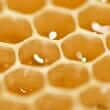
- Female worker honeybees of the genus Apis produce beeswax. The naturally white wax turns yellow or brown after it mixes with pollen oils. Synthetic versions of beeswax have been manufactured to resemble natural beeswax.
- Beeswax has been a commonly used ingredient in the manufacturing of candles, cosmetics, skin creams, and medicinal products for centuries. In folk medicine it has been used as an antiseptic in wound healing and in ear candles to remove earwax.
- Beeswax has been incorporated into many food products, including chewing gum, coffee, tea, and surface-treated fresh vegetables.
- Clinical study suggests that beeswax may be useful for the treatment of skin disorders and skin infections. D-002, a component of beeswax, may be effective in the treatment of some gastrointestinal disturbances caused by nonsteroidal anti-inflammatory drugs (NSAIDs), such as ibuprofen (Motrin® or Advil®) and naproxen (Aleve® or Naprosyn®). Compounds in beeswax are being studied for their potential antioxidant, anti-inflammatory, and cholesterol-lowering properties.
Ingredients
Beeswax
Explore the available health information, treatment context, and integrative evidence for Beeswax.
Evidence Ledger
Grades describe the evidence for Beeswax relative to each listed condition or goal.
Background
References
- Al-Waili, NS. Mixture of honey, beeswax and olive oil inhibits growth of Staphylococcus aureus and Candida albicans. Arch Med Res 2005;36(1):10-13.
View Abstract - Al-Waili, NS. Clinical and mycological benefits of topical application of honey, olive oil and beeswax in diaper dermatitis. Clin Microbiol.Infect. 2005;11(2):160-163.
View Abstract - Al-Waili NS, Saloom KS, Al-Waili TN, et al. The safety and efficacy of a mixture of honey, olive oil, and beeswax for the management of hemorrhoids and anal fissure: a pilot study. ScientificWorldJournal 2006;6:1998-2005.
View Abstract - AntolÃn EM, Quiñónez YB, Canavaciolo VG, et al. Validation of an analytical method for quality control of residual solvents (n-hexane and acetone) in D-002: new active ingredient from beeswax. J Pharm Biomed Anal 2008;47(3):646-50.
View Abstract - Attama AA, Schicke BC, Müller-Goymann CC. Further characterization of theobroma oil-beeswax admixtures as lipid matrices for improved drug delivery systems. Eur J Pharm Biopharm 2006;64(3):294-306.
View Abstract - Buchwald R, Breed MD, Greenberg AR, et al. Interspecific variation in beeswax as a biological construction material. J Exp Biol 2006;209(Pt 20):3984-9.
View Abstract - Fabra MJ, Jiménez A, Atarés L, et al. Effect of Fatty acids and beeswax addition on properties of sodium caseinate dispersions and films. Biomacromolecules 2009;10(6):1500-7.
View Abstract - Hargrove, JL, Greenspan, P, and Hartle, DK. Nutritional significance and metabolism of very long chain fatty alcohols and acids from dietary waxes. Exp.Biol Med (Maywood.) 2004;229(3):215-226.
View Abstract - Illnait, J, Terry, H, Mas, R, et al. Effects of D-002, a product isolated from beeswax, on gastric symptoms of patients with osteoarthritis treated with piroxicam: a pilot study. J Med Food 2005;8(1):63-68.
View Abstract - Junghans, V, Geier, J, and Fuchs, T. Allergy to propolis caused by beeswax-containing ointment. Am.J.Contact Dermat. 2002;13(2):87.
View Abstract - Lanigan RS, Yamarik TA, Cosmetic Ingredient Review Expert Panel. Final report on the safety assessment of PEG-6, -8, and -20 sorbitan beeswax. Int J Toxicol 2001;20 Suppl 4:27-38.
View Abstract - Lübbe J, Sanchez-Politta S. Propolis, beeswax, and the sensitization potential of topical calcineurin inhibitors. Clin Exp Dermatol 2006;31(1):147-8.
View Abstract - Mendoza S, Noa M, Pérez Y, et al. Preventive effect of D-002, a mixture of long-chain alcohols from beeswax, on the liver damage induced with CCl4 in rats. J Med Food 2007;10(2):379-83.
View Abstract - Navarro-Tarazaga ML, Del RÃo MA, Krochta JM, et al. Fatty acid effect on hydroxypropyl methylcellulose-beeswax edible film properties and postharvest quality of coated 'Ortanique' mandarins. J Agric Food Chem 2008;56(22):10689-96.
View Abstract - Navarro-Tarazaga ML, Sothornvit R, Pérez-Gago MB. Effect of plasticizer type and amount on hydroxypropyl methylcellulose-beeswax edible film properties and postharvest quality of coated plums (cv. Angeleno). J Agric Food Chem 2008;56(20):9502-9.
View Abstract